 Recessed Light Calculator
MARKING & ASSEMBLY FIELD GUIDE
IC Rated Recessed Lighting: How to Check Labels and the Complete Assembly
Type IC is an insulation-contact marking for a recessed luminaire. It is not a visual category, and it does not automatically answer whether a fixture is air-tight, wet-location listed, or appropriate for a fire-resistance-rated ceiling assembly.
Use the installed product’s exact marking and current instructions. This guide helps organize that check; it does not approve an installation.
FOUR LABELS · FOUR DIFFERENT QUESTIONS
- IC
- Insulation contact
- Air-tight
- Air-sealing claim
- Wet
- Exposure condition
- Fire-rated
- Tested assembly condition
A claim has scope only where the exact documentation says it applies.
What “Type IC” Means—and What It Doesn’t
For the recessed luminaires described in UL’s guide information, a luminaire marked “TYPE IC” may be installed with insulation or other combustible materials in contact with and over its top. The marking applies to that luminaire as evaluated and installed under its instructions—not to every recessed light that looks slim, uses LEDs, or shares a brand name.
Read UL’s Luminaires Marking and Application Guide, Supply Marking 57 (Type IC), printed p. 32 / PDF p. 34. Markings 60, 62 and 63 on that same page explain trim correlation, convertible IC/non-IC combinations, and rough-in/finishing sections. Match the applicable product category and instructions; these notes are not a new certification for an installed fixture.
Start from the physical product or its exact catalog number. The manufacturer’s instructions can add configuration, component, mounting, wiring, and location conditions that do not appear in a search result or a retail title. If the fixture is older, altered, or has an unreadable label, treat the rating as unconfirmed until the exact documentation is matched.
Type IC is not a light-output specification. Keep it out of the calculator’s lumens, watts, and beam-angle inputs; those fields come from a matching photometric configuration. The spec-sheet guide separates installation ratings from planning inputs.
Find the Exact Marking Before You Change Conditions
Look first for the fixture’s installed marking and catalog/model number, then locate the current manufacturer instruction sheet for that same item. The location varies by product: a housing, remote driver or junction box, light module, trim, packaging, or documentation may carry different parts of the identity. Do not use a color, an opening size, an LED claim, or a generic “canless” description as a substitute.
- Record what is installed. Photograph the labels before removal and write down the full catalog number, any revision, and every separable component you can identify.
- Find the matching instruction sheet. Confirm its model numbers, applicable variants, and issue date. A family page may include options that your actual product does not have.
- Read the applicable statement in context. Look for Type IC or insulation-contact language, then read its related installation conditions rather than extracting one word from a marketing feature list.
- Resolve a mismatch before proceeding. A missing, partially legible, or nonmatching mark is a reason to get product-specific review—not a cue to choose the most favorable nearby listing.
Check the Complete Listed Assembly
Some recessed products are one integrated unit; others combine a housing and trim, or a remote driver/power supply and a light module. Where components are separable, confirm that the documentation correlates the actual parts before carrying a rating from one part to the complete installed assembly.
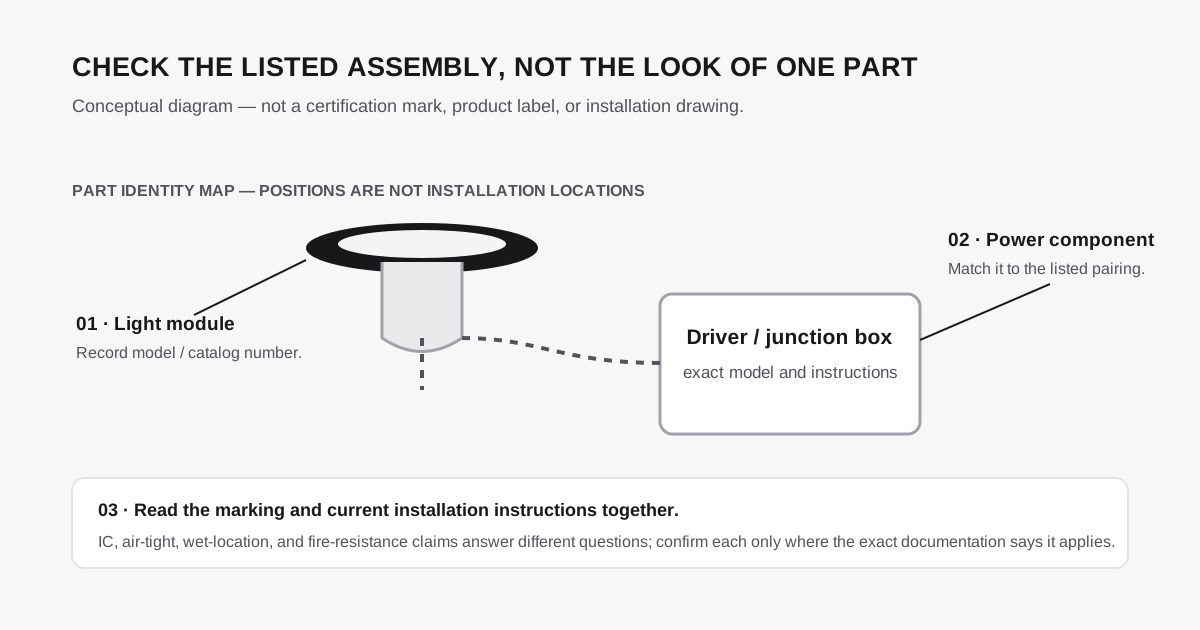
- 01 · Identify
- Find the installed product’s model or catalog number. A trim color, aperture size, LED label, or product family name does not establish an IC rating.
- 02 · Match
- When the fixture has separable parts, use the manufacturer’s correlation marking and instructions to confirm the housing or luminaire, trim or light engine, driver or power unit, junction box, and any required accessory belong together.
- 03 · Verify the property
- Read the exact model’s marking and current instructions for the specific condition being checked. This conceptual diagram is not a certification mark, product label, or installation drawing.
UL’s guide information describes correlation markings for recessed luminaires that use a housing and trim or rough-in and finishing sections. That is why a product photo or a label from just one piece is incomplete evidence. Use the selected manufacturer’s document for the actual product arrangement; component names and marked combinations vary.
Write down these before making an insulation-contact decision
- Exact catalog number and model/revision of the housing or luminaire, trim/light engine, separate driver or power unit, and junction box.
- The manufacturer’s documented permitted combination—not merely parts that physically connect.
- The exact Type IC or insulation-contact statement, the insulation type or other installation restrictions it names, and the current instruction revision.
Keep IC, Air-Tight, Wet, and Fire-Resistance Claims Separate
Each label solves a different installation question. A product may document more than one property, but one property does not prove another. Record the source and exact model beside every claim instead of making a single “safe for anything” note.
| Property | Question it answers | What it does not establish |
|---|---|---|
| Type IC | Whether the listed recessed luminaire is intended for direct contact with insulation or other combustible material, as marked and installed. | Air leakage, a wet location, a fire-resistance-rated ceiling assembly, lumen output, or compatibility with every component. |
| Air-tight / AIR-TITE | Whether this exact product claims an air-sealing property under its own documentation. | Insulation-contact suitability, wet-location suitability, or fire resistance. |
| Wet-location listed | Whether the stated fixture configuration is documented for its described wet-location use. | IC, air-tight, or fire-rated status; check the intended location and instructions separately. |
| Fire-rated / fire-resistance use | Whether a product or protective system is documented for a named tested fire-resistance-rated assembly and its conditions. | A general IC rating. Do not infer this from a wafer form, ceiling opening, or a separate fire cover. |
For shower or other exposure questions, use the fixture’s exact location documentation and the shower lighting guide. For an opening in a fire-resistance-rated floor-ceiling or roof-ceiling assembly, UL explains that a recessed luminaire’s use may depend on a full-scale tested assembly or a specifically certified protective system. IC alone does not answer that assembly question.
Read Product Claims as a Model-Specific Evidence Set
A current HALO HLB4 Slim Canless LED Downlight sheet is a useful example of why labels must be separated: it describes the model as suitable for IC or non-IC applications and separately lists AIR-TITE and wet-location-listed features. Those statements support only the specified HLB4 product/options in that document; they do not establish the same properties for every canless downlight or every component sold under a similar name.
HLB4 document: product claims
The official sheet names IC/non-IC suitability, AIR-TITE, and wet-location-listed features separately. Its p. 3 also limits Type IC to air-permeable insulation, says direct contact with spray foam is not recommended, and explicitly addresses the supplied remote driver/junction box. Record those conditions with the label.
QuickLink document: component boundary
A separate HALO QuickLink sheet states that its power supply is Non-IC while its LED units are IC rated. A label on the light engine does not automatically describe every accompanying power component.
Primary product sources: HALO HLB4 slim canless downlight specification sheet and HALO QuickLink 0–10V specification sheet, accessed October 14, 2026. They illustrate specific documentation patterns, not endorsements, universal rules, or a substitute for current instructions.
Does an IC-Rated LED Retrofit Make an Existing Non-IC Housing IC?
Not from the retrofit label alone. A compatible retrofit description does not itself convert the original housing’s marking or conditions. Check the existing housing and the exact product documentation for an explicit allowed combination or conversion path; if that evidence is absent, keep the housing’s condition unresolved and obtain product-specific review.
This check is about the complete installation, not whether an LED module runs cooler, fits the opening, or looks like the listed product. Retain the original housing label and the retrofit’s full catalog number together when asking for documentation.
Sources and Scope
Maintained by Recessed Light Calculator. This guide combines the primary sources below with an original conceptual component-check diagram. It is not a certification lookup, product test, installation instruction, or site inspection.
- UL Luminaires Marking and Application Guide (PDF) — 2016 edition, Supply Markings 57 / 60 / 62 / 63, printed p. 32 / PDF p. 34; accessed October 14, 2026. Use current model instructions for the actual installation.
- UL Solutions: The Influence of Recessed Luminaires in Fire Resistive Assemblies — accessed October 14, 2026.
- HALO HLB4 specification sheet and HALO QuickLink specification sheet — model-specific examples accessed October 14, 2026.
Recheck the exact model, complete component list, instruction revision, intended location, construction, and applicable local requirements before purchase or work. A qualified installer must determine installation suitability. See model assumptions or report a source issue.